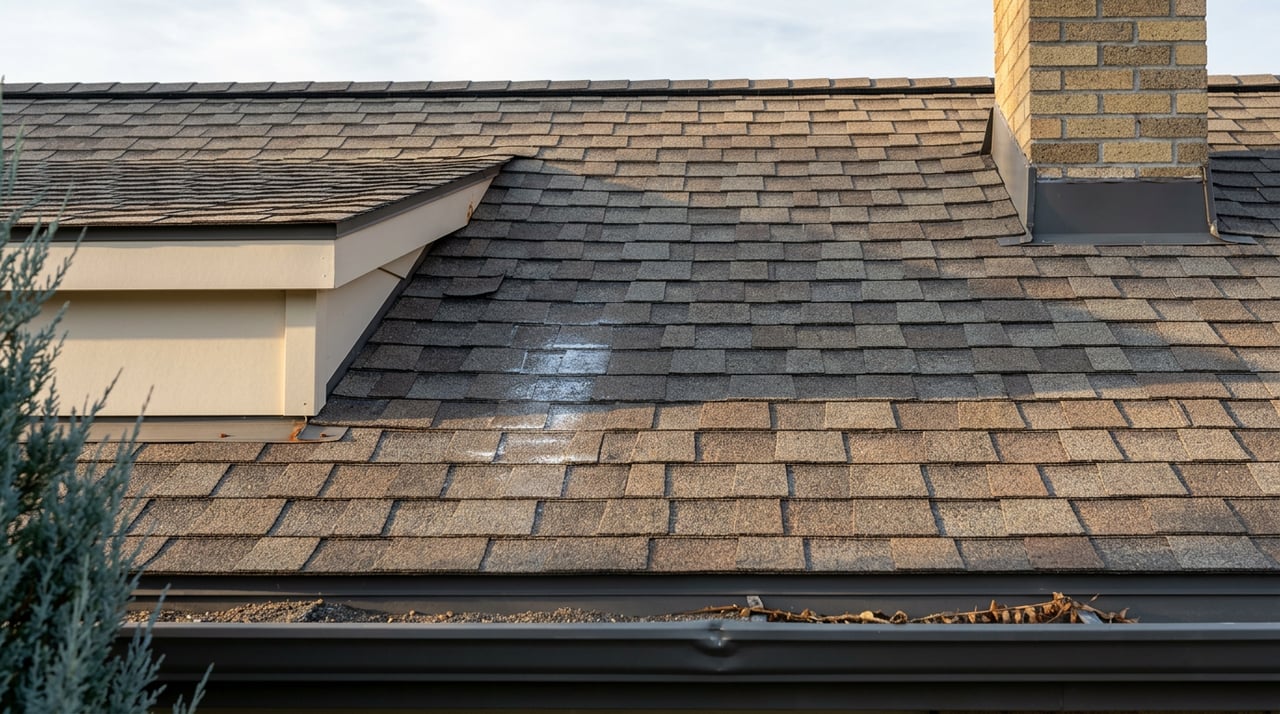
The number that shows up on every listing site for Stonegate looks calm this year. Prices have held close to flat, which normally reads as a sign of a market taking a breath. But a flat median can hide a split that has nothing to do with square footage, finish level, or lot size. In Stonegate right now, the thing quietly separating one home's real cost from another's is the roof, and specifically how old it is and whether it was ever replaced after a storm.
That split is invisible on a listing page. It shows up two weeks before closing, when an insurance quote comes back higher than expected, or doesn't come back at all.
The Binder That Shows Up Last
Ask anyone who closes Denver Metro transactions for a living where deals stall in 2026, and the answer keeps coming back to the same place: the insurance binder. Everything else on a file can be buttoned up, the inspection resolved, the appraisal in, the loan approved, and the binder is still the piece everyone is waiting on. When it arrives late or the quote comes back different than the one used to build the loan estimate, the lender's numbers shift, the settlement statement gets redone, and the closing date moves with it.
That pattern is not a Stonegate-specific quirk. It is a Front Range-wide shift built on hard numbers. Colorado's homeowners insurance loss ratio hit 115% in 2023, meaning carriers paid out more in claims than they collected in premium, then repriced sharply and landed closer to 70% by 2024. Premiums across the state have climbed more than 100% since 2019, the steepest increase in the country. Insurers responded by tightening the one variable they can actually control before writing a policy: the roof.
Why Stonegate Sits Right in the Middle of This
Stonegate is not a single-era subdivision. Homes here were built across roughly two decades, from the late 1980s through the mid-2000s, with a handful of newer additions layered in more recently. Walk two blocks in either direction and you can pass a home built in 1990, one built in 1999, and one finished in 2003 or later. That range matters more than it used to, because Colorado insurers now treat roof age as one of the biggest levers on whether a policy is written at standard terms, written at a markup, or not written at all.
A roof between zero and ten years old typically still qualifies for the widest range of carriers and the best terms. Once a roof crosses into the ten-to-fifteen-year range, underwriting gets more selective and documentation starts to matter. Past fifteen to twenty years, many carriers move a policy to actual cash value coverage on the roof, which means a claim gets paid out at depreciated value instead of full replacement cost, or they decline to write a new policy at all.
| Roof age | Typical insurer treatment |
|---|---|
| 0 to 10 years | Best rates, widest carrier options |
| 10 to 15 years | More selective underwriting, condition and documentation matter |
| 15 to 20 years | Often actual cash value settlement, higher hail deductibles |
| 20+ years | Frequent non-renewal or decline, especially without replacement history |
For a Stonegate home built in the late 1990s with an original roof, that puts the property well past the point where most carriers offer their best terms, even if the home has never filed a claim.
The Storm That Quietly Split the Neighborhood
Here is the detail that actually explains the gap in Stonegate, more than build year alone. In May 2017, a hailstorm dropped golf ball sized stones across southern Douglas County, and Stonegate was one of the neighborhoods named in the resulting wave of roof and vehicle damage claims, alongside Stroh Ranch and Idyllwilde. Thousands of claims were filed in the weeks that followed.
That single event created two distinct groups of homes inside the same neighborhood. Houses that took direct hail damage in 2017 often got a full roof replacement through the insurance claim, which means a meaningful share of Stonegate's housing stock is sitting on a roof that is effectively nine years old today, regardless of when the house itself was built. Houses that were spared, or that had only minor damage patched instead of replaced, are still carrying whatever roof went on during original construction, which in parts of Stonegate means a roof pushing 25 to 35 years old.
Two homes, same neighborhood, same era of construction, same price range on paper. One has a roof an insurer will write at standard rates without blinking. The other may need a roof inspection, a higher hail deductible, or a replacement before a carrier will bind coverage at all. None of that shows up in the list price or the median.
There's a second layer to this. Roof damage from hail is cumulative even when it doesn't force a claim. Granule loss from one storm exposes the shingle mat to UV degradation, and the next storm hits that weakened spot harder. A shingle rated for 25 to 30 years in a calmer climate can be functionally compromised well before that on the Palmer Divide, which is the elevated ridge running through Parker and the rest of Douglas County where storms organize and intensify before rolling east. Parker averages three to five hail events a year of an inch or larger, which means even a roof that looks fine from the ground may have taken more hits than its paperwork suggests.
What the Deductible Actually Costs
The other piece that rarely makes it into a pricing conversation is what a hail claim costs the homeowner out of pocket today, because that math changed too. Flat $1,000 deductibles for wind and hail have mostly disappeared from Colorado policies. In their place, most carriers now write a separate wind and hail deductible set as a percentage of the home's dwelling coverage, typically one to two percent, sometimes higher on older roofs. On a $500,000 home, a two percent deductible is $10,000 out of pocket before the carrier contributes anything.
That number matters for a Stonegate buyer weighing two similarly priced homes. The one with the newer roof is not just cheaper to insure month to month. It also carries a smaller number waiting in the background the next time a storm rolls through Douglas County, which based on the local pattern is a matter of when, not if.
Colorado did just pass a response to this. Senate Bill 26-155, signed by Governor Polis on June 4, 2026, created the Strengthen Colorado Homes Enterprise inside the Division of Insurance, funding grants for resilient roof retrofits on owner-occupied primary residences. The law took effect on August 12, 2026, a little over a month ago as of this writing. It is a real program, and it is worth watching if you own an aging roof in Stonegate. It is not, however, something a buyer can lean on for a home closing this fall. The grant standards are still being finalized, and the enterprise has been clear that applications will not open the moment the law takes effect.
What This Means If You're Pricing or Shopping in Stonegate
If you're selling an original-construction Stonegate home, the roof is no longer a cosmetic detail you can leave for the buyer to discover during inspection. Pulling the paperwork on when the roof was last replaced, whether it happened through an insurance claim, and what material went down, gives your listing a real answer to the question every buyer's lender is going to ask anyway. A documented recent roof with Class 4 impact-resistant shingles is a genuine selling point in this market, not just a maintenance record. Local roofing contractors working Parker and Douglas County, including Parker Roofing Co, note that a full tear-off rather than an overlay is required under current town code, so a documented replacement means a documented compliant one.
If you're buying, the smart move is getting an insurance quote earlier in the process than feels necessary, ideally before your inspection objection deadline rather than after. Ask directly for the roof's age and, if it was replaced, whether that happened through an insurance claim or out of pocket. A seller who can answer that clearly is handing you real information the median price never will.
A Few Questions Worth Asking Before You Write an Offer
Does a roof replacement automatically mean a lower insurance quote? Not automatically. Material matters as much as age. Class 4 impact-resistant shingles tend to earn the best terms, while standard asphalt replaced without an upgrade may still carry the same deductible structure as an older roof, just with a longer runway before the next age threshold.
If my Stonegate home wasn't damaged in the 2017 storm, does that mean the roof is fine? Not necessarily. A roof that avoided a claim can still be original to the house and past the age where carriers offer their best terms. Age and documented condition matter more than whether a claim was ever filed.
Is the new state grant program something I should wait for? Only if you're not closing soon. SB26-155 took effect in August 2026, but the program was not designed to be operational the moment the law took effect, and the standards for what qualifies are still being finalized.
The median price in Stonegate will keep looking steady for as long as portals only track what a house sold for. What it costs to insure, and how smoothly it closes, depends on a line item most listings never mention. If you're weighing two homes in this neighborhood that look identical on paper, the roof is where the real difference lives.
If you're trying to make sense of what a specific Stonegate listing's roof history means for your offer, or you're getting a home ready to sell and want to know what documentation actually moves the needle with buyers, Inleit Properties is glad to walk through it with you. Start your home story, request a personal consultation.
This article is general information, not legal, tax or financial advice. Consult a qualified professional about your situation.
